

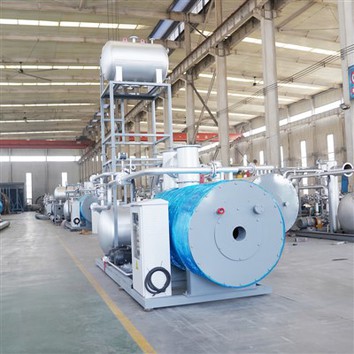
Gas fired thermal oil heaters adopt gas as fuel to heat the thermal oil in the boiler coil. And the heated thermal oil can be used for drying and steam generator. Gas fired thermal oil heaters is cost saving resolution for drying than steam boilers.
Benefits of Gas Fired Thermal Oil Boiler
The simplicity of a thermal fluid heater is its biggest advantage and offers it significant benefits compared to steam boilers. The first is that maintenance on a thermal boiler is cheaper and less cumbersome. The only parts that need regular maintenance are the pump that moves the oil and the burner. In steam boilers, the water and steam can cause deposits and corrosion that reduce efficiency and lead to damage. They also require frequent blowdowns, steam trap maintenance, and water maintenance. The liquids used in thermal heaters don’t typically require adjustments and don’t cause deposits or corrosion.
Thermal fluid heaters have higher efficiency and precision than steam boilers. Thermal fluid heaters can modulate the temperature quickly and precisely, especially when combined with automated controls. This versatility and modulation are critical for applications that require more precise and consistent heating than is possible with steam boilers.
Thermal fluid heaters operate at a significantly lower pressure than steam boilers, making them safer and cheaper. The lower pressure makes the system less susceptible to failure and reduces the frequency needed for inspection and maintenance. Some local, state and federal regulatory bodies address the safety hazards of boiler systems by mandating a boiler attendant who spends a lot of time inspecting the boiler at frequent intervals. Plus, high pressure in these systems requires thicker pipes and materials that cost more during manufacturing. Thermal fluid heaters use less costly materials that don’t need to withstand high pressure and often don’t have as stringent legal requirements as steam boilers.
You can install this type of heater outside to save space in the facility. The oils used in the heating process have a higher freezing point than water, meaning they can pass through tubes placed outside without freezing. Exterior boilers may not be practical for all regions but are a viable space-saving option for others.




Why Choose Us
Our Company
We have more than 130 employees and cover an area of 108 acres, with a total construction area of 29,800 square meters. The first production workshop is 6,800 square meters, the second production workshop is also 6,800 square meters, and the third production workshop is 13,600 square meters. The research and development lab covers 2,600 square meters, the office research and development building is 3,000 square meters, and the living quarters span 1,380 square meters.
Honors and Qualifications
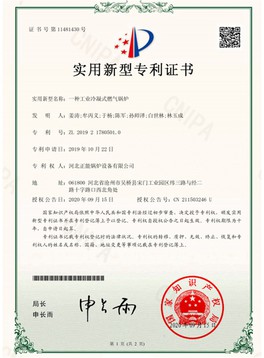
The company has obtained an A2-level pressure vessel license, an A-level boiler manufacturing license, a pipeline pressure fitting license, and GB2 and GC2 pipeline installation licenses. We have also passed ISO 9001 quality management system certification and have been recognized as a high-tech enterprise in Hebei Province.
Production Equipment
Our excellent facilities and manufacturing equipment are guarantees of quality products. Our company has invested in advanced processing and testing equipment from both domestic and international sources, including a laser CNC cutting machine, a CNC drilling machine, automatic submerged arc welding machines, automatic cylinder circular seam welding machines, and real-time online imaging testing equipment. These ensure the reliability of our product quality.
Our Service
The company has a comprehensive after-sales service network to provide full support for your needs. We aim to help you achieve satisfaction with our equipment and ensure that any issues encountered during use are resolved promptly, with our thoughtful service.
The gas thermal oil boiler uses heavy oil, light oil, or combustible liquid as fuel, with thermal oil as a heat carrier. It employs circulating oil pumps to force liquid-phase circulation, transporting heat to heating equipment, and then returning for re-heating in the specialized industrial furnace. The working principle is straightforward; you can refer to the schematic diagram of the gas thermal oil boiler for a better understanding. However, despite its simplicity, attention must be paid to its operation.
First, Checks Before Starting
Ensure that the gas thermal oil furnace and its surroundings are clean and free of debris. Check the furnace, burners, controllers, fire holes, and chimney channels to confirm they are normal.
Turn on the power supply to the heating furnace control cabinet. Check that the voltage is normal and that all indicators and display meters are functioning correctly.
Adjust the gas main pressure reducing valve and secondary pressure reducing valve to maintain the pressure at 0.005 MPa.
Second, Starting the Boiler
Start the thermal oil circulating pump (transport a backup; refer to the pump operating procedures). After starting, allow normal circulation for about 0.5 hours to stabilize the pressure.
Pour through the process equipment and check whether the expansion tank oil level is between 1/4 and 1/2. Confirm that the thermometer and pressure gauge are normal.
Press the burner start button and observe the furnace flame for normal combustion. If ignition fails, troubleshoot the issue and attempt to start the burner again.
Third, Stopping the Gas Thermal Oil Boiler
Normal Shutdown Procedure
Gradually reduce the temperature and turn off the burner to stop combustion.
Wait for the temperature of the hot oil to drop below 70°C, then stop the operation of the thermal oil circulation pump (refer to the pump operating procedures).
Turn off the main power supply and complete handover records.
Emergency Shutdown Procedure
In the event of an emergency requiring an immediate shutdown, quickly turn off the burner. Move the burner hinge axis away from the burner to allow for natural ventilation between the furnace and chimney. This will help dissipate heat stored in the furnace chamber and allow the thermal oil to cool naturally, preventing overheating.

The pressure of a thermal oil boiler can vary depending on the specific design and application. In general, thermal oil boilers are designed to operate at moderate pressures, typically ranging from 10 to 30 bar (145 to 435 psi). However, the pressure requirements can be influenced by factors such as the temperature range needed for the thermal oil system, the specific heat transfer fluid used, and the requirements of the industrial process or application being served.
It's important to note that thermal oil systems are designed to operate at lower pressures compared to steam boilers, as they rely on the circulation of a specialized heat transfer fluid rather than the generation of steam. The pressure of a thermal oil boiler is carefully controlled to ensure safe and efficient operation while meeting the heat transfer requirements of the process it serves.
For specific information about the pressure requirements of a particular thermal oil boiler, it is recommended to consult the manufacturer's specifications, operating manual, or a qualified professional with expertise in thermal oil systems.
The main difference between a steam boiler and a thermal oil heater lies in the medium used for heat transfer. A steam boiler generates steam by heating water, which is then circulated to provide heat or power. The steam carries thermal energy and can be used for various applications such as heating, power generation, or industrial processes.
A thermal oil heater uses a specialized heat transfer fluid, such as thermal oil, to transfer heat to a target process. The thermal oil is heated in the heater and then circulated to the point of use, where it releases its thermal energy to heat the desired application. Thermal oil heaters are commonly used in industries where high temperatures are required for processes such as chemical processing, food production, and manufacturing.
While both steam boilers and thermal oil heaters are used for heat transfer, the key difference lies in the medium they use for transferring thermal energy—water and steam for boilers, and specialized thermal oil for thermal oil heaters. Each system has its own advantages and is chosen based on the specific requirements of the application.
The Sop For Thermal Oil Boiler - Check Before Starting
Check whether the heating furnace and its surroundings are clean without sundries; check whether the furnace body, burner, controller, observation hole, chimney (flue gas duct) are normal.
Know the process, equipment and procedure; check whether the oil level in the expansion tank is above the 1/4-1/2 level, and whether the temperature gauge and pressure gauge are normal.
Turn on the heating furnace via the power switch in the control cabinet; check whether the voltage is normal; check whether the indicator lights and display instruments are normal.
Adjust the primary gas relief valve and secondary gas relief valve to control the pressure to 0.005 MPa.
The Sop For Thermal Oil Boiler - Starting
Start the heat medium oil circulating pump (one working and one standby, according to the sop for water pump), and make the pressure stable after the normal circulation lasts for 0.5 hour.
Press the button to start the burner; check whether the flame in the furnace is normal; if it is not ignited, start the burner again after the troubleshooting.
The Sop For Thermal Oil Boiler - Shutdown Operation
Normal boiler shutdown: a. lower the temperature gradually, stop the burner and combustion; b. stop the heat medium oil circulating pump (according to the sop for water pump) after the oil temperature is lower than 70℃; c. turn off the main power and make the shift records.
Emergency boiler shutdown: stop the burner quickly and move the burner away along the burner hinge at the same time to form the natural ventilation between the furnace and chimney for dissipating the stored heat in the furnace, so as to cool the heat medium oil naturally and avoid overheating.
The Sop For Thermal Oil Boiler - Attention
During the patrol inspection, attention should be paid to check whether there is any leakage around the thermal oil heater. There should be enough fire-frighting equipment for oil and electrical appliances. Water is banned to be the fire extinguishing agent.

Working Steps of Thermal Oil Boiler
Thermal oil circulation
A high-temperature thermal oil is pumped into the boiler. Inside the boiler, the thermal oil is heated by the heater to raise its temperature to the set value.
Heat transfer process
The heated thermal oil enters the heat exchanger from the heater outlet. Here, the thermal oil exchanges heat with the working medium to be heated (such as water, air, etc.). During the heat exchange process, the thermal oil releases heat to the working medium, raising its temperature, while the temperature of the thermal oil itself will drop.
Reflow and reheating of thermal oil
After the heat exchange, the thermal oil with a lower temperature flows back into the boiler and enters the heater again for heating. This cycle is repeated continuously to ensure that the working medium can continue to be heated and heated.
Temperature control
In order to achieve a stable heating effect, the thermal oil boiler adjusts the temperature of the thermal oil and the working medium by controlling parameters such as the circulation speed of the thermal oil and the heating power of the heater. This precise temperature control makes the thermal oil boiler perform well in a variety of industrial applications.
The design of a thermal oil heater is based on the principles of thermal fluid heating. The heater consists of several key components, including the burner, combustion chamber, heat exchanger, and control system.
The burner is responsible for providing the heat energy that is transferred to the thermal oil. It typically uses a fuel, such as natural gas, propane, or diesel, which is burned in a combustion chamber. The combustion chamber is designed to provide the optimal conditions for efficient combustion, and it is usually lined with refractory material to prevent heat loss.
The heat exchanger is the component that transfers the heat energy from the combustion chamber to the thermal oil. It typically consists of a series of tubes that the thermal oil flows through, and the heat is transferred from the combustion gases to the oil by conduction. The heat exchanger is designed to maximize the transfer of heat energy and minimize heat loss.
The control system is responsible for controlling the operation of the thermal oil heater. It monitors the temperature of the thermal oil and adjusts the fuel and air flow to the burner to maintain a constant temperature. The control system also includes safety features, such as over-temperature protection and automatic shut-off, to ensure the safe and reliable operation of the heater.
Daily checks
The operator should perform daily checks of the heater, including checking the fuel level, the temperature of the thermal oil, and the pressure of the system.
Cleaning
The heater should be cleaned regularly to remove any buildup of soot, ash, or other debris that can reduce efficiency or cause damage to the system.
Inspections
The heater should be inspected regularly for signs of wear and damage, such as cracks, leaks, or corrosion. The inspection should include the burner, heat exchanger, piping, and electrical systems.
Lubrication
The bearings, pumps, and other moving parts of the heater should be lubricated regularly to ensure smooth and efficient operation.
Replacement of worn parts
Worn or damaged parts should be replaced promptly to avoid further damage to the system. This may include components such as gaskets, seals, valves, and sensors.
Calibration
The system should be calibrated regularly to ensure accurate temperature and pressure readings.
Water treatment
The thermal oil system should be treated with water treatment chemicals to prevent corrosion and scale buildup.
Our Factory
Hebei Zhengneng Boiler Equipment Co., Ltd. was established in August 2013, is a focus on the development, production and sales of science and technology production enterprises
Hebei Zhengneng Boiler Equipment Co., Ltd. has more than 130 employees. Covers an area of 108 acres, the total construction area of 29,800 square meters, the first production workshop 6800 square meters. The second production workshop is 6,800 square meters, the third production workshop is 13,600 square meters, the research and development experiment workshop is 2,600 square meters, the office research and development building is 3,000 square meters, and the living building is 1,380 square meters.


Certifications
The company has obtained A2-level pressure vessel license, A-level boiler manufacturing license, pipeline pressure fitting license, GB2 and GC2 pipeline installation license, and passed ISO9001 quality management system certification, and won the high-tech enterprise of Hebei Province.


FAQ
We're professional gas fired thermal oil boiler manufacturers and suppliers in China, specialized in providing high quality customized service. We warmly welcome you to buy gas fired thermal oil boiler at competitive price from our factory. Contact us for quotation.
gas fired thermal oil boiler for rubber industry, quality thermal oil boiler, gas fired thermal oil boiler comparison